
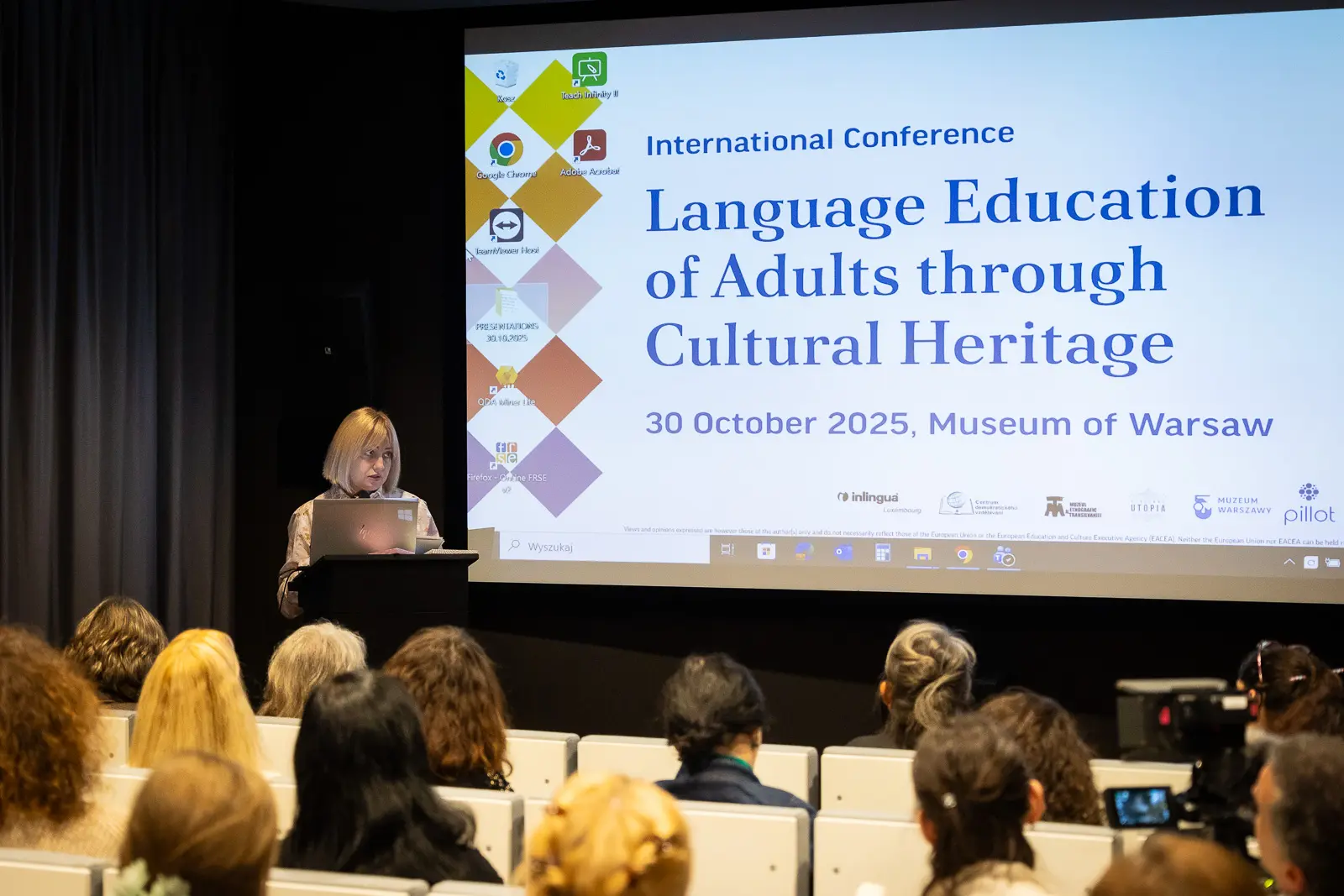
Pillot conference in Warsaw: A day of inspiration and exchange
The International Conference on Language Education of Adults through Cultural Heritage brought together educators, researchers, and cultural institutions from across Europe to explore the transformative power of heritage in language learning. Hosted by the Museum of Warsaw, the event attracted 75 participants and showcased groundbreaking approaches to integrating culture, language, and heritage in adult education.
The conference opened with a warm welcome from the Director of the Museum of Warsaw and Katarzyna Žák-Caplot, who set the stage for a day of dynamic discussions and practical workshops. Participants delved into the intersections of language education, cultural heritage, and intercultural dialogue, with a special focus on inclusive and experiential learning methods.
The morning plenary session featured thought-provoking presentations:
- Piotr Kajak (University of Warsaw, Centre of Polish Language and Culture for Foreigners Polonicum) explored the pedagogical value of popular culture and how can it enrich target language instruction, bridging linguistic and sociocultural learning. Dr. Kajak emphasized the importance of "seducing people with culture", advocating for an inclusive approach: "Culture is cumulative - we shouldn’t eliminate any texts or contexts." He also addressed the challenges and opportunities posed by peoples’ diverse cultural backgrounds, positioning popular culture as a participatory and contemporary reference system that resonates with society.
- Jo-Anne Sunderland (British Museum) introduced the UNESCO Live Museum Model, demonstrating how museums can foster intercultural exchange and language learning through object-based dialogue. She argued for object-based learning as a key framework for language learning and intercultural exchange.
- Fabiana Fazzi and Claudia Meneghetti (Ca’Foscari University) shared insights from the "Io vado al museo" project, highlighting the role of plurilingual education in promoting inclusion for migrant learners and introducing how to help students to fully use their linguistic and cultural repertoire. “Multimodal compositions” were stressed as it is important to guide students to create things from what they learned through post-tasks.
- Katarzyna Žák-Caplot (Museum of Warsaw) presented the PILLOT Project, showcasing how tangible and intangible heritage can be leveraged for language education, especially for refugees and migrants.
The conference sparked fruitful discussions with the audience, particularly around two key challenges:
Supporting Vulnerable Learners: Participants explored strategies for working with learners who have diverse or limited educational backgrounds, such as those with low-level schooling. The focus was on creating inclusive, adaptable approaches to ensure all learners can engage meaningfully with language and cultural education.
The Role of Educators: Another central dialogue addressed who should lead culture-language education. The consensus highlighted the key role of language instructors but also the value of a collaborative tandem - pairing language instructors with cultural educators - to deliver a richer, more holistic learning experience.
Participants delved into the intersections of language education, cultural heritage, and intercultural dialogue.
Participants had the opportunity to get engaged in interactive hands-on learning workshops:
“Herbs, Spices and Your Story”: Led by Katarzyna Žák-Caplot and Anna Bijałd, this sensory workshop introduced one activity from the Pillot project portfolio and showed how to use herbs and spices to spark storytelling and language practice through sensory experience. Pillot project teams from the Czech Republic and Luxembourg also shared experiences from the implementation phase, exploring the foodology area. If you are interested in this activity, check out its profile here on our Pillot learning website.
“Emotion Networking in Language Education”: Monika Michałek guided participants in exploring emotions and cultural associations tied to heritage objects, fostering intercultural awareness and language fluency. Emotion Networking is a very original and engaging activity. See more about it here in our interactive database.
Another workshop was led by Chiara Damiani and Benedetta Montaldi from Stazione Utopia, who showcased innovative practices and interactive activities designed to enhance cultural interpretation. Their session provided participants with practical tools to explore and engage with cultural heritage in meaningful ways.
The afternoon session featured presentations on practical innovative pedagogical applications and current research:
- Jutta Rymarczyk (University of Heidelberg) discussed the potential and challenges of using museums as spaces for foreign language learning, sharing action research from the Museum Ludwig in Cologne.
- Iwona Dronia (University of Silesia) explored how material culture can serve as a powerful tool for developing pragmatic competence in language learners. As the saying goes, "What is said is not what’s being communicated" - a principle that underscores the importance of understanding the unspoken meanings embedded in cultural contexts. Dr. Dronia’s work highlights how objects like a traditional teapot or the layout of a classroom can convey social norms, values, and intentions that words alone may not express. By integrating material culture into language education, learners gain the ability to interpret these implicit messages, fostering deeper intercultural awareness and more effective communication.
- Katarzyna Papaja (University of Silesia) profiled the CLIL teacher, emphasizing the importance of reflective practice and professional development.
- Dorota Piwowarczyk (Poznań Heritage Centre) showcased how discovering local cultural heritage can be made exciting and relevant in language teaching. She stressed the importance of discovering elements of shared culture and local contexts as learning a language is not enough to build a sense of community, because “It´s people who make cities”.
The conference concluded with the introduction of the project´s resources, especially the launch of the PILLOT Project’s new educational publication, Cities that Speak: Europe in Languages and Cultural Styles - a “walkbook” published by the Museum of Warsaw that embodies an ecological approach to learning, transforming the city itself into a dynamic educational environment. The Polish version of the Sabir game was also introduced, offering an interactive tool for language and intercultural exploration.
In a touching reflection, Yuliia Olishevska shared the profound impact of her participation in the PILLOT Project’s implementation phase at the Museum of Warsaw, highlighting its benefits for learners. She stressed “the role of Erasmus+ projects for people with migratory backgrounds.”
The event was also attended by representatives of the Polish National Agency FRSE. Erasmus+ Adult education sector specialist Joanna Replin highlighted the professional and methodological quality of the project and its impact.
The event closed with a guided tour of the Museum of Warsaw, led by Monika Michałek, providing participants with a firsthand experience of the city’s rich cultural and linguistic heritage.
The conference left participants inspired by the transformative potential of heritage-based language education - an approach that fosters inclusion, creativity, and intercultural understanding. By connecting language learning with cultural heritage, educators can create meaningful, inclusive, and engaging educational experiences that resonate with real-life contexts.
An intercultural approach is intrinsic to language teaching. When educators integrate objects, stories, and spaces into instruction, they empower learners to develop not only linguistic skills but also cultural awareness and a sense of belonging.
The event showcased the PILLOT Project’s innovative practices while enriching them with cutting-edge scientific research and diverse perspectives from educators across Europe. Together, these insights highlighted how heritage-based methods can redefine language education for the better.